



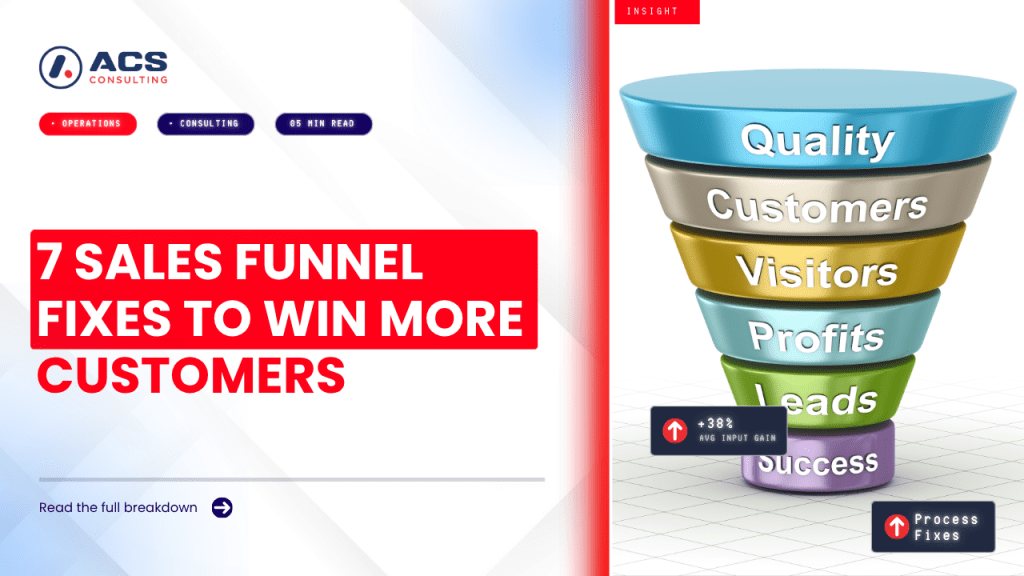
Most business owners can tell you how many jobs they won last month. Far fewer can tell you how many enquiries came in, how many turned into quotes, and where the rest quietly disappeared. That blind spot is exactly what a sales funnel fixes. It maps the journey from stranger to paying customer so you can see where people drop off and fix the leak — rather than assuming you simply need more leads. In a 2026 where every enquiry costs money to generate, that visibility is worth real profit.
This guide explains what a sales funnel is, the stages it contains, how to find your leaks, and the mistakes to avoid — written in plain, practical terms for Australian trades, construction and professional-services owners.
WHAT IS A SALES FUNNEL?
A sales funnel is the path a potential customer travels from first hearing about you to actually paying you. It’s called a funnel because it narrows: plenty of people notice you, fewer enquire, fewer again ask for a quote, and only some of those become customers.
The value of thinking in terms of a sales funnel is that it turns a vague process into visible stages you can measure and improve, instead of one mysterious gap between marketing and revenue.
THE STAGES OF A SALES FUNNEL
The labels vary, but the practical stages are much the same in any business:
- Awareness — people discover you exist, through search, referral, signage or advertising.
- Interest — they look you up, check reviews, and decide whether you’re worth contacting.
- Enquiry — they call, email or fill in a form.
- Quote — you assess the job and give them a price.
- Decision — they accept, decline, or go quiet.
- Delivery and beyond — the work itself, then repeat business and referrals.
Mapping your own sales funnel against these stages is usually the first time an owner sees where the business is actually losing people.
WHY THE SALES FUNNEL MATTERS
When work is slow, the instinct is almost always to generate more leads. But if only a small share of your enquiries turn into quotes, or your quotes rarely convert, adding leads just pours more water into a leaking bucket — you spend more to get the same result.
Fixing a weak stage is usually cheaper and faster than buying more traffic. Lifting your quote conversion even modestly can be worth more than a substantial increase in enquiries, and it costs nothing in advertising.
FINDING YOUR BIGGEST LEAK
The real power of the sales funnel is that it shows you where to focus. Count what happens at each stage over a typical month — enquiries received, quotes sent, jobs won — and the weakest link usually announces itself. Some businesses have plenty of enquiries but convert almost none, which points at pricing, responsiveness or how quotes are presented. Others convert nearly everything they quote but barely get enquiries, which points at marketing and visibility. These two businesses need completely opposite fixes, and without the numbers most owners guess wrong and spend money on the wrong problem entirely. One month of honest counting will tell you more about where your revenue is going than a year of assumptions.
HOW TO IMPROVE YOUR SALES FUNNEL
1. Measure each stage
Track enquiries, quotes and wins so you can see your conversion at each step. A sales funnel you haven’t measured is just a diagram.
2. Respond faster
Speed of response is one of the strongest predictors of winning work. Many jobs are lost simply because someone else called back first.
3. Improve how you quote
Present quotes clearly, explain what’s included, and follow up. A better quote process lifts conversion without a single extra lead.
4. Follow up on quotes
Most owners send a quote and wait. A polite follow-up a few days later recovers a surprising share of jobs that would otherwise vanish.
5. Fix the weakest stage first
Put your effort where the drop-off is biggest rather than spreading it evenly. The narrowest point sets your whole result.
SALES FUNNELS FOR TRADES AND CONSTRUCTION
For trades and construction, the sales funnel is usually short but leaks badly at two predictable points. The first is response time — enquiries that sit unanswered for a day or two are frequently gone, because the customer rang three businesses and went with whoever got back to them. The second is quote follow-up, where quotes are sent into silence and never chased. Both are entirely fixable without spending a cent on marketing: answer or return calls quickly, get quotes out while the conversation is still fresh, and make one polite follow-up call a standard part of the process. For most trade businesses, tightening these two stages produces more new work than any advertising campaign would.
COMMON SALES FUNNEL MISTAKES TO AVOID
- Assuming you need more leads. If conversion is the problem, extra leads just cost more for the same result.
- Not measuring anything. Without numbers at each stage, you’re guessing which problem to fix.
- Slow responses. Delays lose work to whoever answered first, regardless of who’s better.
- Never following up quotes. Sending a price and waiting silently forfeits jobs you’d have won by asking.
Turning enquiries into won work is core ACS Consulting territory. The Strategy & Business Planning (https://acsconsulting.com.au/services/strategy-and-business-planning/) service maps your sales funnel and works out which stage to fix first, while the SME Data Analysis & Power BI (https://acsconsulting.com.au/services/sme-data-analysis/) service builds the tracking that shows your conversion at each step and the Operations & Process Improvement (https://acsconsulting.com.au/services/operations-and-process-improvement/) service builds the quoting and follow-up systems that lift it. The free WA Tradie Revenue Multiplier (https://acsconsulting.com.au/wa-tradie-revenue-multiplier/) shows the revenue hiding in enquiries you already get. The Australian Government’s marketing resources (https://business.gov.au/marketing), Business Queensland on marketing and sales (https://www.business.qld.gov.au/running-business/marketing-sales), and data from the Australian Bureau of Statistics (https://www.abs.gov.au/) offer useful context.
FREQUENTLY ASKED QUESTIONS
What is a sales funnel?
A sales funnel is the path a potential customer travels from first hearing about you to paying you. It’s called a funnel because it narrows — many people notice you, fewer enquire, fewer request a quote, and only some become customers.
What are the stages of a sales funnel?
Typically awareness, interest, enquiry, quote, decision, then delivery and repeat business. The labels vary between businesses, but mapping your own process against these stages shows where you’re actually losing people.
How do I improve my sales funnel?
Measure enquiries, quotes and wins so you can see conversion at each stage, respond to enquiries faster, present quotes more clearly, follow up on quotes you’ve sent, and put your effort into the stage with the biggest drop-off first.
Do I need more leads or better conversion?
Count your stages and the answer becomes obvious. Plenty of enquiries but few wins points at pricing, responsiveness or quoting. Few enquiries but high conversion points at marketing and visibility. The two problems need opposite fixes.
CONCLUSION
A sales funnel makes visible what most businesses only guess at — where potential customers are dropping away. Measure each stage, respond faster, quote better, follow up properly, and fix the weakest point before spending more on leads.
Understand your sales funnel and you stop buying traffic to fill a leaking bucket — winning more work from the enquiries you’re already generating right through 2026.
Need expert guidance for your business?
ACS Consulting
Website: acsconsulting.com.au
Email: zoey@acsconsulting.com.au
Phone: 0452 665 021
Contact ACS Consulting today to discuss your business goals and discover practical solutions that drive measurable results.