



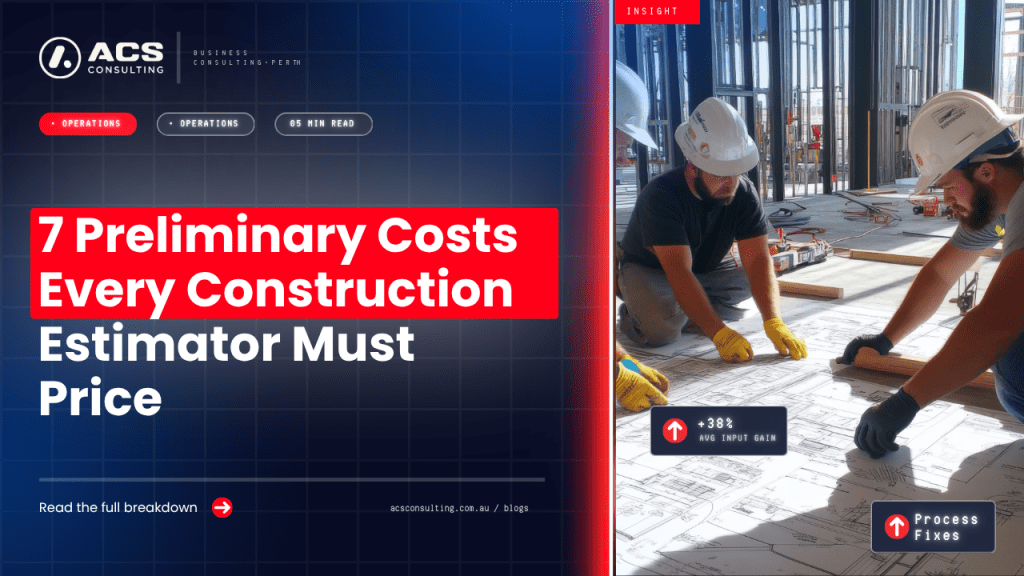
When people look at a construction estimate, they focus on the obvious costs — the materials, the labour, the measured work that becomes the finished building. But there’s a whole category of cost that doesn’t turn into a single brick or beam, yet is essential to getting the job done: the construction preliminaries. These are the project-wide costs of running the site and the job itself, and getting them right is one of the most important and most commonly underestimated parts of pricing a project accurately. Understanding preliminaries is essential for anyone estimating or managing construction work.
This guide explains what construction preliminaries are, what they include, why they matter, and how to handle them — written in plain, practical terms for Australian builders, estimators and contractors.
WHAT ARE CONSTRUCTION PRELIMINARIES?
Construction preliminaries — often just called “prelims” — are the costs of running a construction project as a whole, rather than the cost of any specific measured item of work. They’re the expenses of setting up, managing, servicing and running the site and the project, which don’t belong to any single element of the building but are needed to deliver the whole job.
The key distinction is between preliminaries and the measured work. Measured work is the actual construction — the concrete, the framing, the fit-out — that can be quantified against the drawings. Construction preliminaries are everything else it takes to run the project around that work, and they’re priced separately because they don’t attach to any one item.
WHAT PRELIMINARIES INCLUDE
Construction preliminaries cover a wide range of project-running costs. Common examples include:
- Site management — supervisors, site managers and project management on the job.
- Site setup and facilities — site sheds, amenities, temporary services, fencing and signage.
- Plant and equipment — cranes, hoists, scaffolding and shared equipment for the whole site.
- Temporary works — access, protection and temporary structures.
- Insurances, permits and compliance — project insurances, approvals and safety requirements.
These construction preliminaries are essential to running the job, and because they can add up to a significant slice of the total, leaving them out or underestimating them is a fast way to lose money on a project.
WHY PRELIMINARIES MATTER SO MUCH
Construction preliminaries matter because they’re both significant in value and easy to underestimate — a dangerous combination. On many projects, preliminaries make up a meaningful percentage of the total cost, so getting them wrong has a real impact on whether the job is profitable. Yet because they’re less visible than the measured work, they’re often the part of an estimate that gets least attention.
The risk is direct. If you underestimate the construction preliminaries — the site management, the plant, the facilities, the time on site — those costs still get incurred; they just come out of your margin instead of the client’s budget. Accurately pricing preliminaries is therefore essential to an accurate, profitable estimate.
WHY TIME ON SITE DRIVES PRELIMINARIES
One of the most important things to understand about construction preliminaries is that many of them are time-related — they cost so much per week for as long as the project runs. Site management, site sheds, amenities, plant hire, temporary services and much else are ongoing costs that accumulate with every week you’re on site. This has a crucial implication: the duration of the project directly drives the preliminaries cost, so if a job takes longer than planned, the preliminaries blow out even if nothing else changes. It also means delays are doubly costly — not only through their direct effects, but because they extend the time-related preliminaries. This is why accurately estimating the project duration is central to pricing construction preliminaries correctly, and why delays and extensions of time are such a significant commercial issue: an extension of time without the associated preliminaries cost recovered can leave a contractor carrying weeks of site-running costs out of their own pocket. Understanding the link between time and preliminaries is essential to both pricing and protecting your margin.
HOW TO HANDLE PRELIMINARIES
1. Identify all the project-running costs
List everything needed to run the job that isn’t measured work. Thorough identification is the foundation of accurate construction preliminaries.
2. Estimate the project duration carefully
Work out realistically how long the job will take. Because many preliminaries are time-related, duration drives the cost.
3. Price time-related items per week
Cost the ongoing items by their weekly rate across the project. This makes the effect of duration on preliminaries clear.
4. Don’t forget the one-off costs
Include setup, establishment and fixed costs alongside the time-related ones. Complete construction preliminaries capture both.
5. Protect preliminaries in delays
Ensure extensions of time recover the associated preliminaries cost. This protects your margin when the job runs long.
COMMON CONSTRUCTION PRELIMINARIES MISTAKES TO AVOID
- Underestimating them. Because preliminaries are less visible than measured work, they’re often priced too low, eating into margin.
- Ignoring the time link. Missing that many preliminaries are time-related means duration blow-outs aren’t priced for.
- Not recovering them in delays. An extension of time without preliminaries recovery leaves you carrying site-running costs.
- Leaving items out. Forgetting site facilities, plant or management understates the true cost of running the job.
Getting the full cost of a project right is core ACS Consulting territory. The Construction Estimation & Cost Consultancy service ensures your construction preliminaries are captured accurately so your estimates are complete and profitable, while the Operations & Process Improvement service tightens the site management and scheduling that drive preliminaries costs, and the SME Data Analysis & Power BI service helps you track project costs against budget. The free Perth SME Operational Audit Checklist helps you tighten your estimating processes. For authoritative guidance, the Australian Institute of Quantity Surveyors, Master Builders Australia, and the Australian Government’s managing money resources are useful references.
FREQUENTLY ASKED QUESTIONS
What are construction preliminaries?
Construction preliminaries, or “prelims”, are the costs of running a construction project as a whole rather than the cost of any specific measured item of work. They cover setting up, managing, servicing and running the site and project — things like site management, facilities, plant and insurances — and are priced separately from the measured work.
What do construction preliminaries include?
They include site management (supervisors and project management), site setup and facilities (sheds, amenities, temporary services, fencing), plant and equipment shared across the site (cranes, scaffolding), temporary works, and project insurances, permits and compliance costs. These are the essential costs of running the job around the measured construction work.
Why do construction preliminaries matter?
Because they’re both significant in value and easy to underestimate. Preliminaries can make up a meaningful percentage of a project’s total cost, so getting them wrong affects profitability directly. Since they’re less visible than measured work, they often get too little attention — and any shortfall comes straight out of your margin.
Why are preliminaries linked to project duration?
Because many preliminaries are time-related — site management, sheds, plant and services cost so much per week for as long as the job runs. This means project duration directly drives the preliminaries cost, so delays blow them out. It’s why estimating duration accurately and recovering preliminaries in extensions of time are so important.
CONCLUSION
Construction preliminaries are the project-wide costs of running the job that don’t attach to any single item of work, and pricing them accurately is essential to a complete, profitable estimate. Identify all the project-running costs, estimate the duration carefully, price time-related items per week, include the one-off costs, and protect preliminaries in delays.
Because preliminaries are significant, time-driven and easily underestimated, the estimator who gives them proper attention protects the margin that a focus on measured work alone would quietly lose. Treat construction preliminaries as the important cost centre they are, and your estimates will be far more reliable.
Need expert guidance for your business?
ACS Consulting
Website: acsconsulting.com.au
Email: zoey@acsconsulting.com.au
Phone: 0452 665 021
Contact ACS Consulting today to discuss your business goals and discover practical solutions that drive measurable results.