



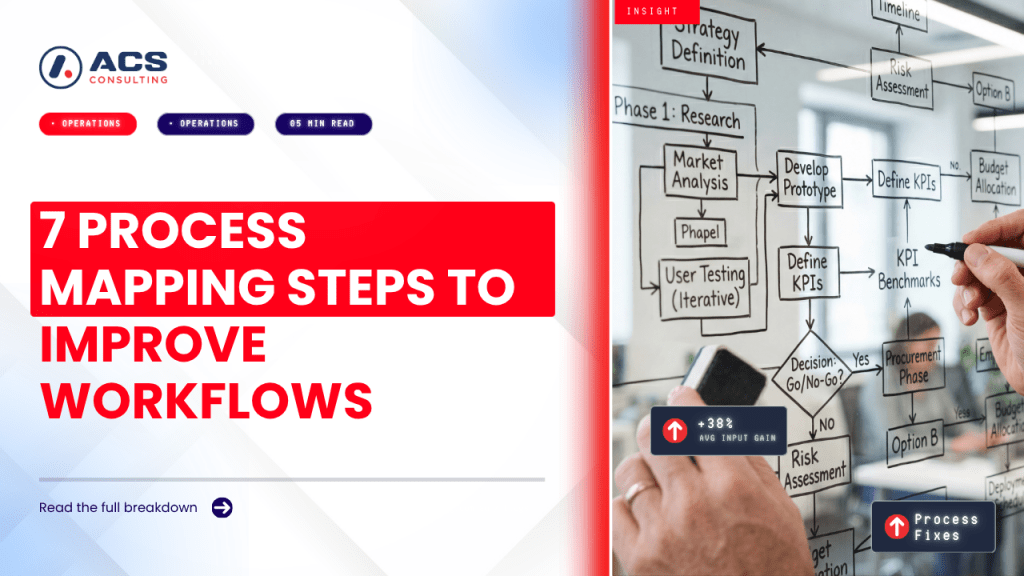
Most business problems — the missed steps, the bottlenecks, the “who was supposed to do that?” moments — come down to processes that live only in people’s heads. Process mapping fixes that by drawing your workflow out where everyone can see it, turning a vague sequence of tasks into a clear picture you can actually improve. It’s one of the simplest, most powerful tools for making a business run smoothly, and it costs nothing but a bit of thought. In 2026, it’s often the first step toward genuine efficiency.
This guide explains what process mapping is, why it matters, how to do it, and how it drives improvement — written in plain, practical terms for Australian trades, construction and professional-services owners.
WHAT IS PROCESS MAPPING?
Process mapping is the practice of visually documenting the steps in a business process from start to finish — who does what, in what order, and how the work flows between them. The result is a simple diagram, or map, that shows exactly how a task actually gets done.
By making an invisible workflow visible, process mapping lets you see the whole thing at a glance, spot where it breaks down, and agree how it should run. It replaces vague assumptions about how work happens with a shared, agreed picture.
WHY PROCESS MAPPING MATTERS
You can’t improve what you can’t see. Process mapping reveals the bottlenecks, duplicated effort, unnecessary steps and hand-off gaps that quietly cost you time and money every day. Once a process is on paper, inefficiencies that were invisible become obvious and fixable.
It also creates consistency. A mapped process is one everyone can follow the same way, which means reliable results, easier training, and far less reliance on any single person’s memory. When a key person is away, the work still gets done properly.
HOW TO MAP A PROCESS
1. Pick a process to map
Start with one important or troublesome process — quoting, onboarding a customer, or completing a job. Focused process mapping beats trying to capture everything at once, and gives you an early win to build on.
2. Define the start and end points
Be clear about what triggers the process and what marks it complete. Clear boundaries keep your process map focused and useful, rather than sprawling into everything the business does.
3. List every step in order
Walk through the process as it actually happens, capturing each step, decision and hand-off along the way. Map the real process, not the idealised version, so the map reflects reality and the problems it contains are the real ones worth fixing.
4. Involve the people who do the work
The people doing the job know the real steps, including all the informal workarounds they’ve developed. Mapping with them makes the process map accurate and gets their buy-in for the changes that follow, which is half the battle in making improvements stick.
5. Review and improve
With the whole process finally visible, look for steps to simplify, combine, automate or remove entirely. This is where process mapping turns from documentation into real improvement, and where the time you invested starts to pay off.
USING PROCESS MAPS TO DRIVE IMPROVEMENT
A process map isn’t the goal in itself — it’s the tool that makes improvement possible. Once your workflow is laid out clearly, you can ask sharper questions of every step: Is this necessary? Why does it take so long here? Where do things get stuck or handed off badly? The map turns vague frustration into specific, fixable problems. From there you can redesign the process to cut waste, remove bottlenecks and smooth the hand-offs, then update the map to become your new standard way of working. That’s how process mapping becomes the foundation of continuous improvement rather than a one-off exercise.
PROCESS MAPPING FOR TRADES AND CONSTRUCTION
For trades and construction businesses, process mapping brings order to the workflows that often run on memory: quoting and estimating, scheduling jobs, ordering materials, running a site, and invoicing. Mapping these reveals where jobs stall, where information gets lost between the office and the site, and where steps quietly get missed. Once mapped and improved, these processes run more smoothly and depend far less on one person holding it all together in their head — which is exactly what lets a trades business grow without the owner becoming the bottleneck.
COMMON PROCESS MAPPING MISTAKES TO AVOID
- Mapping the ideal, not the real. A map of how work should happen in theory misses the actual problems.
- Doing it alone. Mapping from your desk without the people who do the work produces an inaccurate picture.
- Over-complicating it. A map so detailed that nobody ever reads it helps no one at all; keep it clear and simple.
- Mapping then shelving it. A process map that never actually drives any change was simply wasted effort.
Making your processes visible and better is core ACS Consulting work. The Operations & Process Improvement service maps your key processes and redesigns them to cut waste and bottlenecks, while the SME Data Analysis & Power BI service measures how well they perform and the Strategy & Business Planning service links better processes to your growth. The free Perth SME Operational Audit Checklist helps you find the processes worth mapping first. The Australian Government’s business resources, Business Queensland, and productivity analysis from the Productivity Commission offer useful guidance.
FREQUENTLY ASKED QUESTIONS
What is process mapping?
Process mapping is the practice of visually documenting the steps in a business process from start to finish — who does what, in what order, and how work flows between them. The result is a simple diagram showing exactly how a task actually gets done.
Why is process mapping important?
Because you can’t improve what you can’t see. Process mapping reveals the bottlenecks, duplicated effort and gaps that quietly waste time and money, and it creates consistency so work is done the same reliable way regardless of who does it.
How do I map a business process?
Pick one important process, define its start and end points, list every step in the order it really happens, involve the people who do the work, then review the map to simplify, combine or remove steps.
What’s the difference between a process map and an SOP?
A process map is a visual diagram of how work flows through a process, while a standard operating procedure is the written detail of how to perform it. They work well together — the map shows the flow, the SOP explains each step.
CONCLUSION
Process mapping makes your invisible workflows visible, turning vague, recurring problems into specific and fixable ones. Pick a single process, define its boundaries clearly, capture every real step with the people who actually do the work, then review it carefully to cut waste and smooth the flow.
Use process mapping well and you build a business that runs on clear, consistent systems rather than memory and daily firefighting — the foundation of efficiency, easier growth and far less key-person dependency through 2026.
Need expert guidance for your business?
ACS Consulting
Website: acsconsulting.com.au
Email: zoey@acsconsulting.com.au
Phone: 0452 665 021
Contact ACS Consulting today to discuss your business goals and discover practical solutions that drive measurable results.